Self-Driving Car
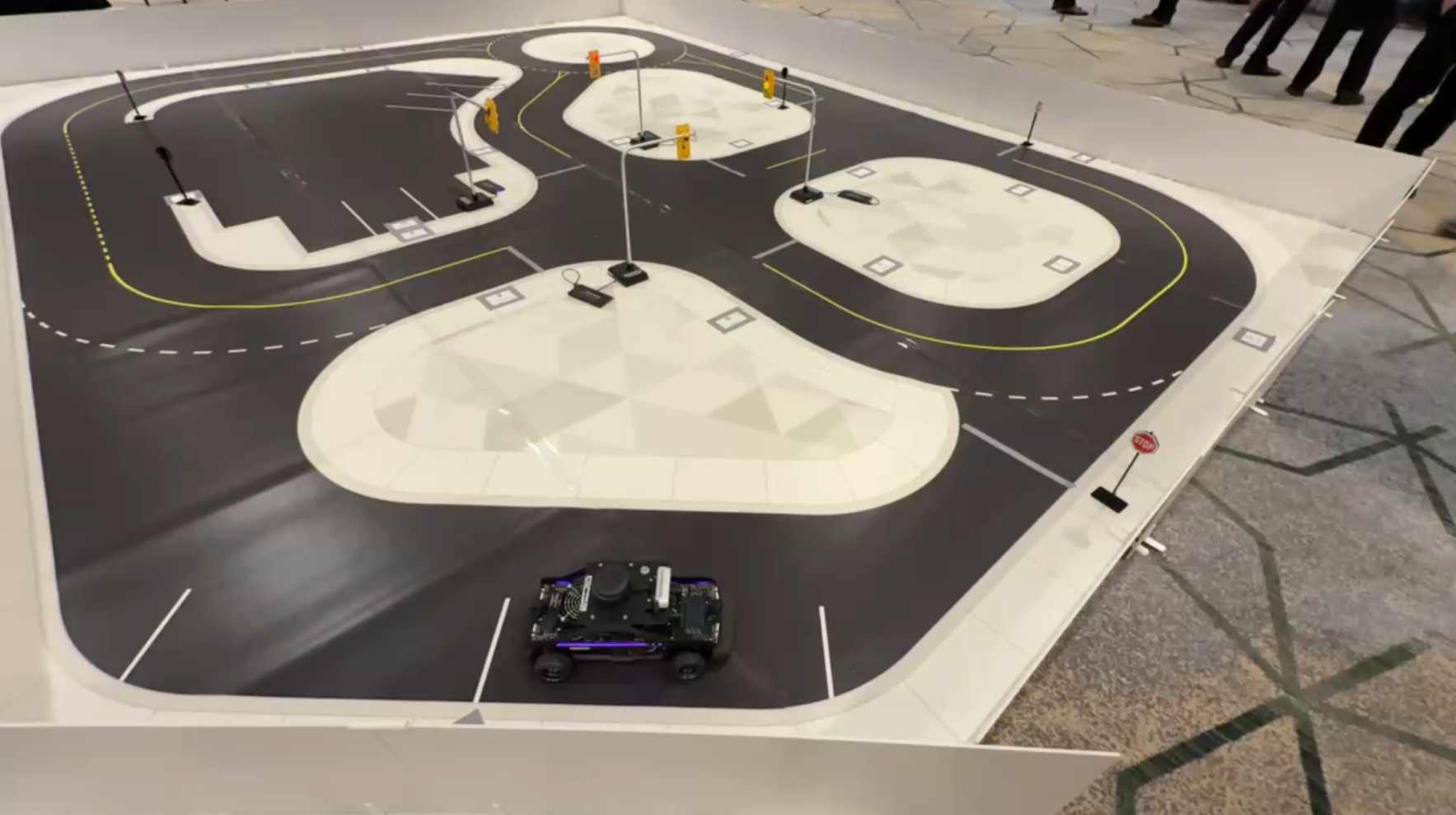
Quanser Self-Driving Car Student Competition at the 2025 American Control Conference.
Overview
I participated in the Quanser Self-Driving Car Student Competition, held at the 2025 American Control Conference (ACC) in Denver, Colorado. The competition simulated an Uber-like autonomous driving environment, where teams programmed a self-driving car to navigate a city map, pick up passengers, drop them off at target locations, and return to a home base while obeying traffic laws. Teams were scored based on the complexity and number of routes completed within a fixed time limit.
Team Structure & My Role
Our team of three divided the system into three core components:
- Perception: Camera-based detection of stop signs and traffic lights
- State Estimation: Localization using LiDAR and wheel encoders
- Control: Path planning and trajectory tracking
I was responsible for the control subsystem, focusing on global path planning and low-level path following for an Ackermann-drive vehicle.
Control System Design
Roadmap & Path Planning
To support flexible route selection, I designed a directed graph roadmap consisting of 52 nodes, connected by a combination of straight-line segments and circular arcs.
The roadmap encoded:
- Road geometry
- Legal driving directions
- Locations of stop signs, traffic lights, and yield signs
I implemented Dijkstra’s algorithm on this roadmap to compute shortest paths between arbitrary pickup and drop-off locations, enabling efficient route planning during competition runs.
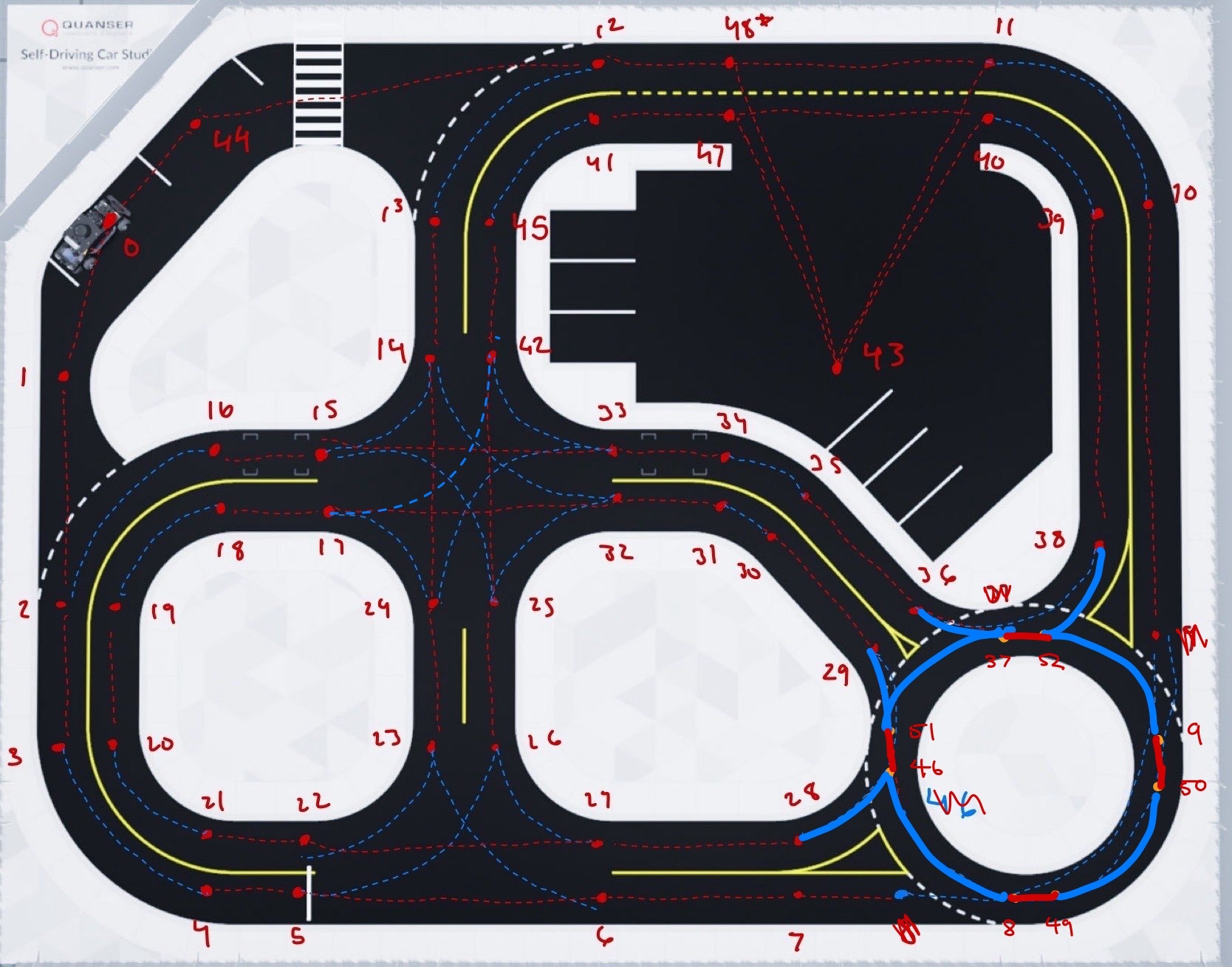 Hand-designed roadmap representing the competition environment
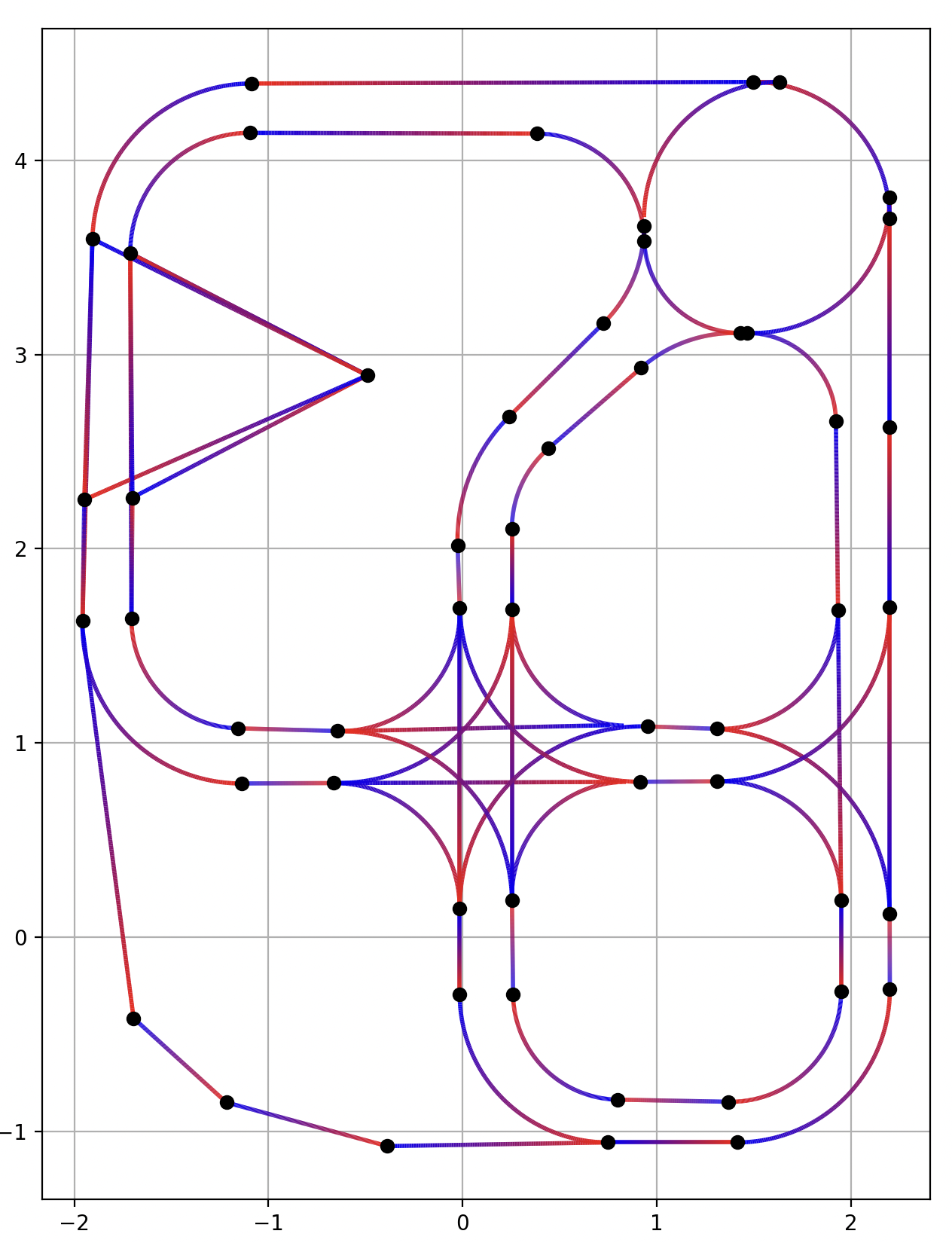 Directed graph implementation with line segments and arcs used for path planning
Path Following & Control
For trajectory tracking, I implemented a Pure Pursuit controller using ROS 2 and Python.
Key features:
- Ackermann steering-compatible control
- Smooth tracking of both straight and curved path segments
- Real-time command generation for vehicle steering and velocity
This controller allowed the car to reliably follow planned routes from point A to point B.
Competition Results & Lessons Learned
Our team competed at ACC and placed 6th out of 28 teams. While our control system performed as intended, overall performance was affected by system-level issues:
- Traffic light detection failures in the vision system caused penalties for running red lights
- Movable foam-core walls in the environment reduced localization accuracy
- As a result, we prioritized simpler routes over longer, more complex ones
Despite these challenges, the competition provided valuable experience working with ROS 2, multi-module autonomous systems, and the realities of deploying autonomy in imperfect, real-world environments.
Demo
Demo of the car following a planned route during competition